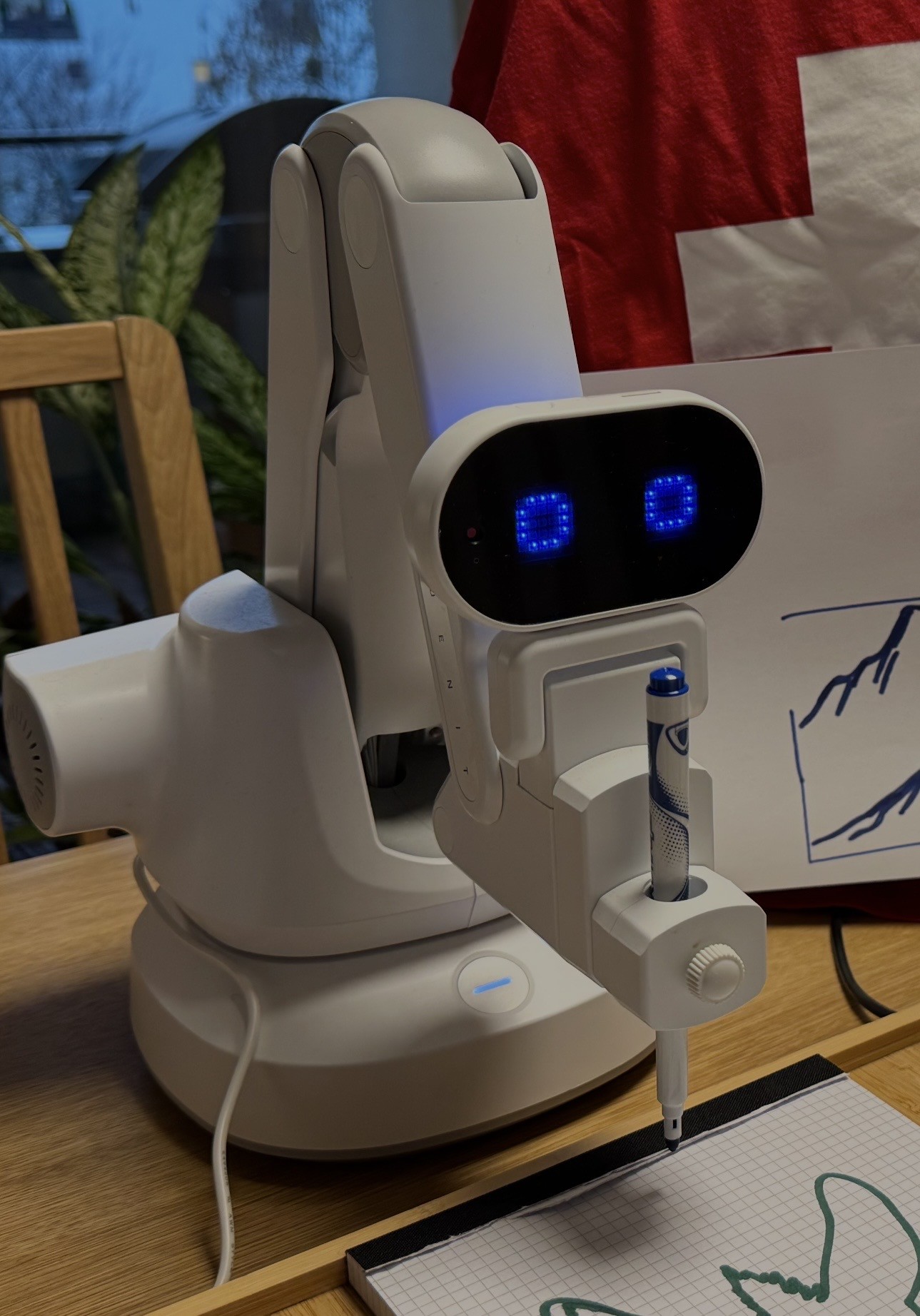
The Huenit arm — pen loaded, ready to draw.
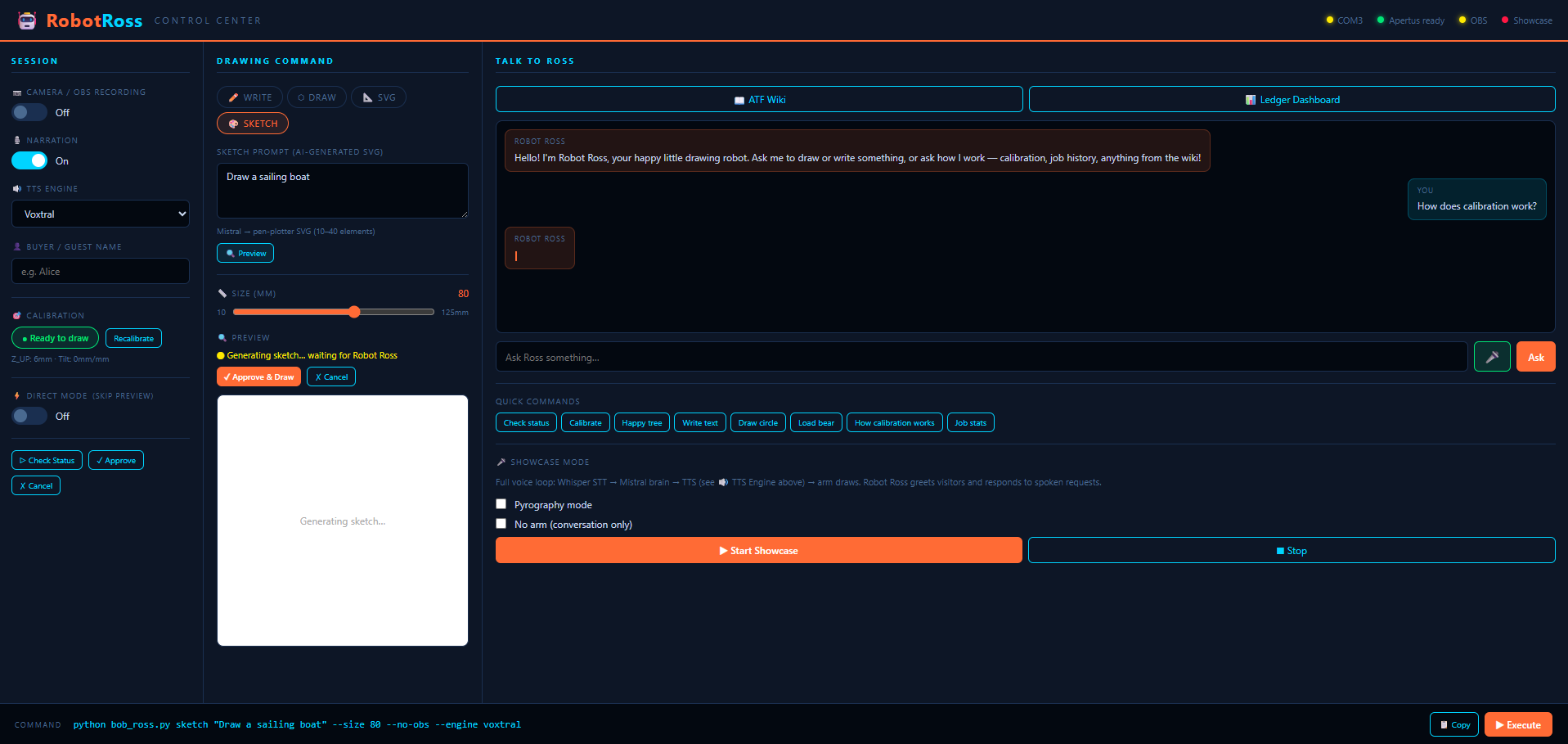
The Control Center — draw commands on the left, "Talk to Ross" chat on the right.
Agentegra Robotics
A physical proof that agentic infrastructure can execute real work: a robot arm that draws and narrates, fully local, no cloud model in the loop. Currently running on Mistral for the Mistral Hackathon, Paris 2026.
Robot Ross is a live demonstration of Agentegra's sovereign agentic infrastructure. We chose a robot arm painting on canvas to make the technology tangible and verifiable — but the architecture is identical to an industrial deployment. Replace the pen with a drill bit, replace the canvas with a workpiece, and this is a CNC manufacturing cell running its own decision-making on-premise, with a local model doing the reasoning.
The Huenit arm — pen loaded, ready to draw.
The Control Center — draw commands on the left, "Talk to Ross" chat on the right.
A Huenit robot arm takes a text prompt, spoken request, or SVG, draws it on paper, and narrates the process live — Bob Ross style — using a fully local AI model. Every job logged. Every answer about the system sourced.
A real agentic system that plans, executes, and explains physical work — with a local model doing the reasoning at every step.
Industrial-grade physical execution on consumer hardware — proving the architecture works before scaling to full CNC. Runs on a Mac Mini M4 or, for the hackathon build, a Windows laptop.
Fully local, open-weights model via Ollama. No API calls, no cloud dependency for the core loop. Ministral narrates each creation in the style of Bob Ross, composes freeform sketches, and drives the chat brain — the story is generated entirely on-device.
A chat panel in the Control Center that turns natural-language requests into confirmed arm commands, and answers real questions about the system — "how does calibration work?", "how many jobs have run?" — grounded in the robot's own documentation and ledger.
A local RAG service over the project's own wiki and operational ledger, answering questions with cited sources instead of guessing. See section 04 or the live demo.
Text-to-speech via Mistral's Voxtral model gives Ross an actual spoken voice, live, as it narrates — not a scripted or pre-recorded track.
Arm control, narration, sketch generation, and Q&A all run offline on commodity hardware. Hosted Mistral is available as an explicit, opt-in escalation — never automatic.
The same loop that turns a sketch prompt into a pen stroke turns a work order into a CNC toolpath.
A request comes in via the Control Center UI (write / draw / SVG / sketch) or spoken aloud in unattended Showcase Mode.
Ministral 3 8B, running locally via Ollama, turns the request into a structured scene or narration script — no cloud round-trip.
The Huenit arm draws the piece over USB serial G-code, hard-capped at a 125mm drawing area.
Narration is generated and spoken aloud via Voxtral (or Kokoro locally) in sync with the drawing.
Every job is recorded to the order ledger. ATF can answer questions about job history, calibration, or system internals on demand — see below.
A minimal, local-first stack — everything below runs on one laptop, no server required.
flowchart TD
  U["🧑 Operator"] -->|"Draw / Write / Sketch / Chat"| C["Control Center UI\nlocalhost:7870"]
  C --> B["bob_ross.py\norchestrator"]
  B <-->|"narration, scene parsing, chat"| M["Ministral 3 8B\nOllama, local"]
  B -->|"speak"| V["Voxtral TTS\nMistral API"]
  B --> H["Huenit Arm\nUSB serial"]
  B --> L["orders.xlsx\njob ledger"]
  C <-->|"grounded Q&A"| T["ATF Server\n:8771"]
  T --> M
  T -.->|"opt-in escalation"| HM["Hosted Mistral\napi.mistral.ai"]

  style C fill:#0A7A6F,color:#fff,stroke:#0A7A6F
  style B fill:#0C1C28,color:#fff,stroke:#2A4A55
  style M fill:#152535,color:#7AAABB,stroke:#2A4A55
  style T fill:#152535,color:#7AAABB,stroke:#2A4A55
  style V fill:#152535,color:#fff,stroke:#2A4A55
  style H fill:#152535,color:#fff,stroke:#2A4A55
  style L fill:#152535,color:#fff,stroke:#2A4A55
  style U fill:#152535,color:#fff,stroke:#2A4A55
  style HM fill:#0C1C28,color:#159988,stroke:#159988
Control Center UI (localhost:7870) · drawing controls + "Talk to Ross" chat · Showcase Mode for unattended voice-loop demos
Ministral 3 8B via Ollama for narration, scene composition, and chat · Huenit robot arm control · zero cloud model dependency by default
Local RAG service (port 8771) over the project's wiki and job ledger · local Ministral by default, hosted Mistral (mistral-medium-3-5) as an opt-in escalation only
OBS recording + camera proof-of-work capture, built during the original Mac Mini build. Not used for the hackathon, kept functional for later.
A robot that can explain itself: sourced answers about the build, grounded in its own documentation and operational history.
The EU AI Act (deadline August 2026) expects traceability and human oversight for physical AI systems. ATF is our answer at demo scale: a small local RAG service that indexes the project's own wiki and job ledger, then answers questions with cited sources instead of a confident guess.
In the Control Center, the same "Talk to Ross" chat box that turns a request into a drawing command also answers questions like "how does calibration work?" or "how many jobs have run?" — routed to ATF instead of a generic reply.
Ministral 3 8B answers most questions fully on-device. Hosted Mistral (mistral-medium-3-5 → mistral-large-2512) is available as an explicit, opt-in escalation — never triggered automatically.
Every answer cites the wiki page or ledger entry it came from. If the corpus doesn't cover something, ATF says so instead of fabricating a plausible-sounding answer.
The original commercial model, kept here for context — a 64-slot installation that proved the core thesis: any physical process can accept orders from human or AI buyers alike.
The Wall of Fame was an 8×8 grid of physical 10cm squares (A1–H8), each claimable by any buyer — human or AI agent.
Any slot could be outbid. If an agent paid 20% more than the current "rent" for a square, the robot drew over it — competitive, continuous.
Every drawing generated a YouTube Short logged against the order — the same proof-of-work instinct that now lives on, dormant, in the OBS/camera pipeline.
The Shopify + commerce infrastructure behind this was later reused for the Classical Reels project. The dashboard code still exists in the repo; it just isn't deployed anymore.
Robot Ross uses a pen. An industrial deployment uses a drill bit. The command interface, the local model, the sourced audit trail via ATF — identical. What we've built is not a demo. It's the production architecture running at proof-of-concept scale.
Agentic GDP will surpass human GDP only when agents exist in the physical world. Robots are embodied agents. This is where we start.
Follow the build, watch it draw, or ask it a question yourself.